I didn’t expect the clearest thinking about AI doom I’ve heard this year to come from Ben Affleck.
Still, he’s earned a hearing on the subject. He founded an AI post-production company, InterPositive, and Netflix bought it this year for roughly $587 million, according to its 10-Q. In a recent interview on One More Question, the host asked him about the creative community’s ambivalence toward AI. He corrected the word: “Ambivalence, a lot of like terror and rage. And I understand why.”
What followed was a short, sharp argument in three parts. I keep turning it over.

AI doom as a sales pitch
His first point is about who is doing the talking. The loudest voices, he says, are either puffing up their chests or advertising a product. Both routes run through the same sentence: this is so powerful it’s going to wipe everything out. Which is why we need to control it. Or, alternatively, which is why you need to download our model.
Then comes the line that belongs on the wall of every AI company’s sales office: “Going out and saying, ‘We’re going to wipe out half of white-collar work,’ does little to stir enthusiasm to adopt your product.”
He’s right, and not only commercially. Anyone who hears that a technology is coming for their livelihood will feel concerned. “The notion that that’s somehow a surprise baffles me.” In short, if your go-to-market depends on frightening the people who are supposed to use your product, you have built a fundraising story, not an adoption story.
His remedy is plain. Judge a forecaster the way you’d judge anyone else: by how their past predictions turned out.
Why AI doom spreads: we have to know what a lion sounds like
His second point is about why AI doom spreads so easily. We remember threats most sharply, he says, because “we have to know what a lion sounds like.” Meanwhile, we pay far less attention to the good things, or the safe ones.
My own training was in microbiology and molecular biology before it was in software, and this framing lands for me. Biology is full of systems tuned to over-react. After all, a false alarm is cheap, and a missed predator is not. Evolution doesn’t optimize for accuracy; it optimizes for survival, and survival favors the anxious.
That’s useful to know about ourselves. However, it doesn’t make every alarm true. “Are we doomed?” is the most clickable question there is, and there is real power in being the authority who answers it. So an audience that understands why it’s drawn to the lion’s roar is better placed to ask who benefits from making it.
Good at aiming
His third point is the one I find most useful, because it replaces a vague fear with a precise one.
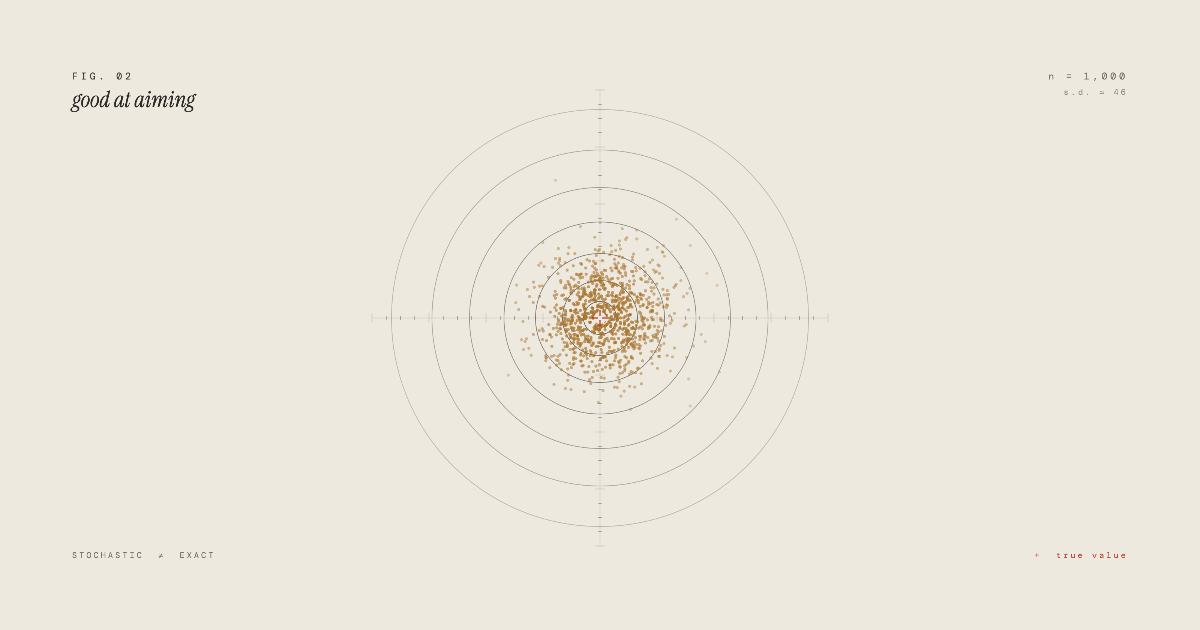
He doesn’t think AI becomes Skynet. Instead, the danger he names is handing a stochastic system the controls over decisions where being wrong kills people: targeting for weapons, automated security.
His distinction is worth keeping:
- Deterministic computing is a calculator. It gives the right answer every time.
- Generative AI, by contrast, is stochastic, which “just means like to aim. It doesn’t mean exact. It means good at aiming.”
- Inference is called inference “because you’re inferring.”
So, in his words, “You’d be a fool to say, yes, I’m going to hand the keys over to this in this very important matter.”
That’s not an apocalypse. Rather, it’s an engineering constraint, and engineers know what to do with constraints. I wrote recently about an AI code reviewer that gave one of my pull requests a 5/5, and then I ran the test suite. That’s “good at aiming” in practice. The answer isn’t to fear the reviewer or abandon it. Instead, keep a deterministic check (the tests) anywhere that being approximately right isn’t good enough.
Liability, not panic
Affleck’s closing point is the least dramatic and probably the most important. The counterweight to “the frenetic race to just improve regardless” isn’t terror. It’s ordinary accountability: “If you have a company that hurts people, you’re liable for that.”
That’s how we’ve managed every other powerful, imperfect technology. We didn’t decide each one was salvation or doom. Instead, we got specific about where it can be trusted, where it can’t, and who answers for the difference. I tried to do exactly that for fitness apps in Easy Beats Sophisticated, and the same exercise works here at a much larger scale.
He is, of course, talking his own book. He sold a company built on the thesis that AI won’t replace filmmakers. But a person can have a stake in an argument and still be right about it. On AI doom, I think he is.
The full interview: Ben Affleck on One More Question.